
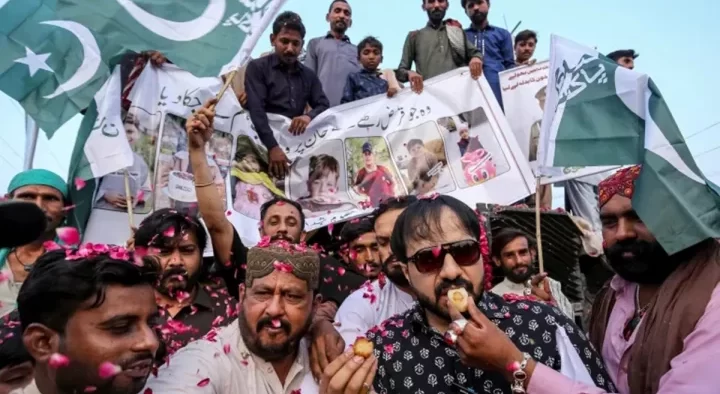
After days of escalating military tension and cross-border strikes, a surprising yet welcome announcement has brought a wave of relief to South Asia. On Saturday, India and Pakistan jointly declared a ceasefire agreement, signaling a temporary end to hostilities and a potential shift toward peace.
This declaration, coming after intense military confrontations at key installations along the border, marks a significant diplomatic breakthrough. The announcement has sparked jubilant reactions across Pakistan, with people taking to the streets to celebrate. In many cities, citizens were seen distributing sweets, waving national flags, and chanting patriotic slogans such as “Long live Pakistan.”
Nationwide Jubilation in Pakistan
According to a live report from Al Jazeera, people in cities across Pakistan have welcomed the ceasefire as a moment of national pride and relief. Streets in Lahore, Islamabad, Karachi, and Rawalpindi came alive with celebration. In several neighborhoods, impromptu rallies broke out, with traditional music playing and sweets being shared among strangers.
Mohammad Fateh, a young man from Lahore, expressed his excitement, saying, “This is a big day for Pakistan. Our forces responded with strength and dignity. India had no choice but to agree to peace.” His statement reflects a sentiment shared by many who view the ceasefire as a diplomatic victory.
In Islamabad, 45-year-old homemaker Zubaida Bibi said with tears in her eyes, “War only brings sorrow and destruction. We are grateful peace is returning. This feels like Eid to me. We have won.”
Relief in Pakistani-Controlled Kashmir
The ceasefire has been particularly welcomed in Muzaffarabad, the capital of Pakistan-administered Kashmir, a region that has witnessed the brunt of cross-border violence over the years.
Zulfiqar Ali, a resident of the area, told local media, “For us, peace means survival. We’ve endured enough suffering. I’m glad that both Pakistan and India have chosen a wise path this time.”
U.S. Mediation Behind the Scenes
The announcement comes shortly after U.S. President Donald Trump revealed that his administration had brokered a deal between the two nuclear-armed neighbors. In a statement posted on his social media platform, Truth Social, Trump wrote:
“After overnight negotiations facilitated by the United States, I’m pleased to announce that India and Pakistan have agreed to a comprehensive and immediate ceasefire. Congratulations to both nations for using common sense and exceptional judgment.”
Shortly after this announcement, both Indian and Pakistani authorities confirmed the ceasefire. Pakistan’s Foreign Minister Ishaq Dar stated, “After a day-long series of diplomatic efforts, we have successfully reached a ceasefire agreement with India. This marks a significant step toward regional de-escalation.”
Indian External Affairs Minister S. Jaishankar echoed the sentiment in an official statement:
“India and Pakistan have today reached a mutual understanding to halt all military operations and cross-border firing. This is a positive move toward ensuring stability and security in the region.”
Public Hopes for Lasting Peace
While the ceasefire has brought immediate relief, long-term peace remains uncertain. Analysts warn that without addressing core issues such as the Kashmir dispute and deep-rooted mistrust, the ceasefire may prove short-lived. However, the general public in both countries is overwhelmingly supportive of diplomatic efforts.
A university student in Islamabad said, “War is never a solution. Only through dialogue, diplomacy, and mutual understanding can we build a peaceful future.”
Conclusion
Today’s ceasefire agreement between India and Pakistan is being hailed as a welcome pause to rising tensions. Although the road ahead remains filled with challenges, this gesture of peace has sown the seeds of hope in the hearts of millions.
For now, Pakistan is celebrating—not just an end to conflict, but the promise of a future where diplomacy triumphs over division.