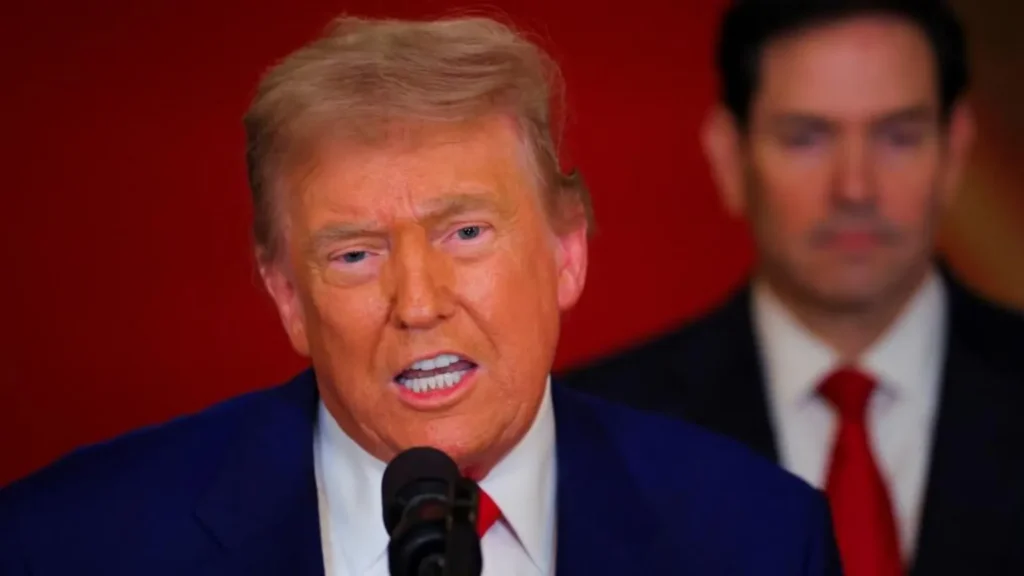
After twelve days of escalating conflict, President Trump ordered bold U.S. airstrikes targeting Iran’s nuclear facilities—Fordow, Natanz, and Isfahan—joining Israel’s prior campaign. Officials describe it as “Operation Midnight Hammer.” Iran responded with a symbolic missile strike on Al Udeid Air Base in Qatar, causing no casualties thanks to advance warning .
On June 23–24, Trump announced a “complete and total ceasefire”, claiming that both Iran and Israel had agreed to halt fire—mediated via Qatar, Vice President Vance, Secretary Rubio, and direct outreach from Trump to Prime Minister Netanyahu . Trump framed it as a diplomatic vindication of his high-stakes military approach, asserting it prevented the U.S. from being dragged into a prolonged Middle East war .
Financial markets reacted positively: oil prices dropped sharply, S&P futures rose, and the dollar weakened—signals that investors see reduced geopolitical risk . Trump celebrated the ceasefire as a “peace moment,” while Israel hailed the strikes for advancing its strategic aims and Iran calling them a “symbolic” response, indicating restraint .
But key questions remain—the durability of the ceasefire is in doubt. Iran’s Foreign Minister Abbas Araghchi stated the pause was contingent on Israel stopping attacks first by 4 a.m. Tehran time; reports from Al Jazeera and Reuters say Israel resumed strikes on Tehran, while Iran denies breach accusations . Observers warn that skirmishes often persist despite cease-fire declarations .
Strategically, while Trump’s strikes appear to have temporarily shifted regional dynamics and disrupted Iran’s nuclear ambitions, experts caution Iranian leadership may pivot to underground enrichment or asymmetric warfare. Concerns also linger over rebuilding nuclear stockpiles and potential future disruptions—especially via threats in the Strait of Hormuz .
Domestically, Trump’s intervention split opinion: some conservatives praised the assertiveness, while “America First” critics argued it contradicts his non‑entanglement promises and risks dragging the U.S. deeper into Middle Eastern conflict .
🔍 Bottom line:Trump’s bold gamble—joining Israel’s air campaign—has, for now, achieved a ceasefire and bolstered global markets. But the real test lies ahead: will hostilities truly end? Can diplomacy lock in gains on Iran’s nuclear ambitions? And could this prove to be a strategic reset… or only a temporary calm before further escalation remains to be seen.